
Our Daily Dose of Digital Placebo
We've become hopelessly addicted to the tools of production, mistaking the elaborate ritual of planning for the messy, terrifying reality of actual work.
cliquer pour ouvrir / exporter la planche signée
Any resemblance to actual persons, living or dead, is purely coincidental.
The glow of the screen is a sterile blue, reflecting in pupils dilated with the grim focus of an addict preparing a fix. The syringe isn’t filled with smack, but with a Gantt chart. The spoon isn’t cooking down tar, it’s color-coding a Kanban board.
Welcome to the clean, well-lit world of placebo productivity. We are the junkies of the to-do list, mainlining the pure, uncut sensation of getting ready to get ready. We’ve OD’d on the process and forgotten the purpose. The most potent drug of the 21st century is a SaaS platform with a slick UI that promises to organize your life into a state of perpetual, frictionless, and ultimately sterile order.
The Great Rearrangement
Behold the modern artist. Their masterwork is not a novel or a canvas. It is a Notion dashboard, a "second brain" so complex it requires a first brain dedicated full-time to its maintenance. Here, the user finds release—not in a finished paragraph, but in the soothing, rhythmic comfort of administration. Dragging a card from ‘To Do’ to ‘Doing.’ Choosing the perfect emoji for a project folder that contains nothing.
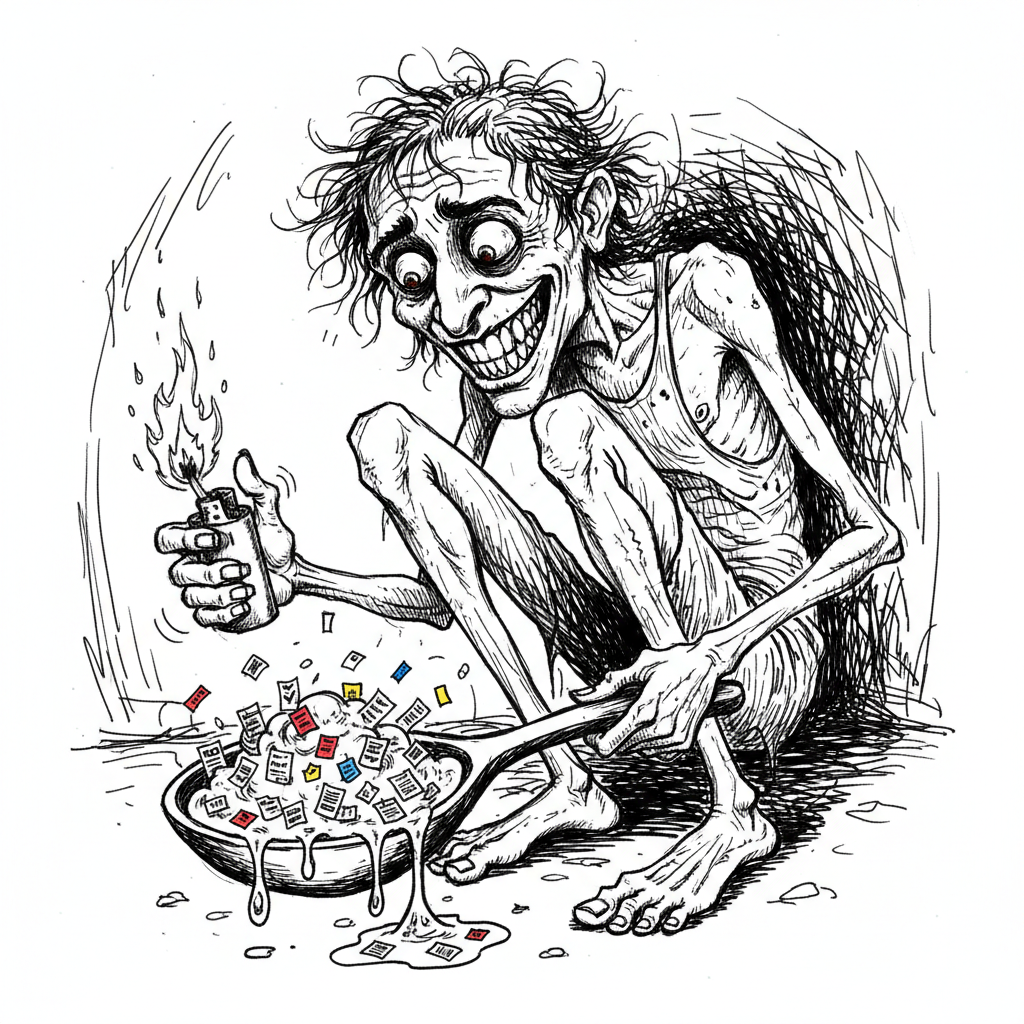
The map has not only replaced the territory; it has burned the territory, salted the earth, and built a beautifully rendered 3D model of the ashes.
This is the high: the feeling of control imposed upon the terrifying chaos of a blank page. The actual work is messy and unpredictable. So the junkie retreats to the one place where progress is guaranteed: the system itself. Polishing the needle is always easier than finding a vein.
What lies at the heart of this addiction? Fear. A primal terror that our ideas are mediocre, that the business will fail, that we simply don’t have it. As long as we are planning, we are safe, insulated from judgment. The tools are our dealers in digital dopamine, selling the sizzle of a steak that will never be cooked. They have gamified the act of doing nothing, lionizing the librarian while forgetting the author.
Read next
Three nearby doses — same dossier, same themes.
May 24, 2026
The Gilded Cage of Getting Things Done
You've color-coded your Kanban board and optimized your workflow into a shimmering monument of efficiency. The only problem? You haven't produced a single damn thing.
Aug 14, 2026
Thank God for the Little Sparkle
It’s in every app, that beautiful little icon, pushing a pure, clean hit of AI perfection right into your document. Are you really still typing your own words?
Jul 20, 2026
Do Nothing, Faster
Thanks to my new AI suite, I now generate world-class summaries of articles I have not read about books I will never open; are you even optimizing your inaction?